
FAQs
Our events are a chance to get up-to-speed on the big issues in education and to develop relationships with other career changers in the Now Teach Network.
We offer opportunities across the year to develop your knowledge and encourage networking.
The sessions focus on a topic previous cohorts have identified as wanting to hear more about. Topics this year include Behaviour, Planning and Assessment, Subject Knowledge and Preparing for your NQT year.
We also hold an annual Now Teach Conference. This is for every Now Teacher, designed and led by career changers tailored to addressing what you need to know for when you start in the classroom and your first two years in teaching.
Your pattern will depend on whether you are on a school or provider-led training route. However, when you first start, you typically will have 6-8 hours a week contact time in class.
This will be a mixture of lessons that you observe, and lead and this balance will change over time. The rest of the time you will be planning, training and reflecting.
Contact time then increases through the school year as you progress. You will sometimes be observed by qualified teachers and sometimes co-teaching alongside an experienced teacher.
You will be asked to complete assignments as part of your teacher training course if you are completing a PGCE these will be masters level assignments.
In addition to teaching and developing your practice you should expect to engage in extra-curricular activity, form time, school duties and meetings.
Ofsted (Office for Standards in Education, Children’s Services and Skills) is a government department that inspects and regulates institutions in England providing education to learners of all ages and providers of care for children and young people.
The following list is a guide to useful acronyms to know:
DfE – The Department for Education
FE – Further Education
HOD – Head of Department
HT – Headteacher
HE – Higher Education
HEI – Higher Education Institute
ITT – Initial Teacher Training
KS – Key Stage
NARIC – National Academic Recognition Information Centre
NQT – Newly Qualified Teacher
OFSTED – The Office for Standards in Education
OTT – Overseas Trained Teacher
PGCE – Post Graduate Certificate in Education
QTLS – Qualified Teacher Learning and Skills
QTS – Qualified Teacher Status
SKE – Subject Knowledge Enhancement
SCITT – School Centred Initial Teacher Training
STEM – Science, Technology, Engineering and Mathematics
SD – School Direct
SEND – Special Educational Needs and Disabilities
SENco – Special Educational Needs Co-ordinator
TA – Teaching Assistant
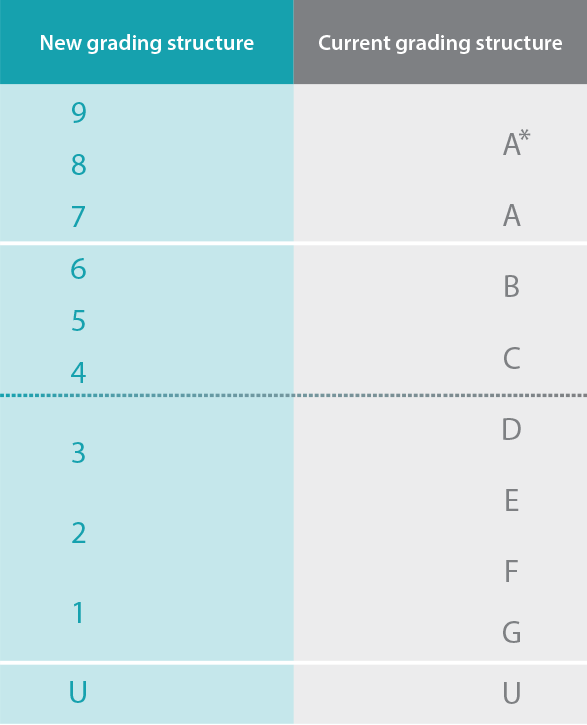
GCSEs in England have been reformed to keep pace with universities’ and employers’ demands. The new grades have replaced letters with numbers with 9 being the highest grade.
They are based on new and more demanding subject content but are still suitable for the same wide range of abilities. The new grade scale makes it clear to everyone that students have studied the new GCSEs.
It also has more higher grades compared to the old A to G grades, to give sixth forms, colleges, universities and employers the opportunity to better distinguish between students of different abilities.
For a table on equivalence see here.
Teaching is a job like few others. It can be stressful, rewarding, challenging, and funny, often within the same hour.
Our founder Lucy Kellaway has documented her experience in training to become a teacher and we would recommend her book: Re-Educated.
We would also recommend reading some of the case studies of our participants.
Behaviour management is something which can be learnt.
However, it takes practice and experience to get it right – that is part of the purpose of teacher training. By the end of their first year, Now Teachers say they feel so much more confident in managing their students' behaviour.
The lessons Now Teachers have learnt is that you must be consistent, you must maintain standards, build relationships with both individuals and the class, and own the classroom.
Lesson planning is key to a successful class. Teacher Toolkit has very good teaching resources.
It is important to make sure your lessons are tailored to your class, enable you to effectively interact with your
class and give you opportunities to check for learning. It is a class, not a presentation.
We run lesson planning sessions to help you prepare before you attend an interview at your prospective training provider.
Once you have completed your training year, you’ll begin on a salary that varies depending on the part of the country you live in.
You then receive a pay rise each year as you progress along the pay scale.
Read about the teacher pay scales here.
In the first training year, Now Teachers will have to pay for their training fees which will around £9250 depending on the training provider.
Participants may be eligible for a student loan to help with this or with their bursary.
As fees can vary full details of fees are provided once you have been placed with a school and training provider. Student loans are only paid back whilst in employment.
You do not pay Now Teach any fees.
During training, and if you’re eligible, you’ll receive a bursary or scholarship from the government that will be paid in monthly instalments. This works in the same way as a salary, but it is tax-free. No elements will need to be repaid.
The amount you’ll get will depend on which subject you wish to teach. Your training provider is responsible for deciding if you are eligible.
To find out more and to see the latest subject bursary allocation, please visit our page on finance and funding.
There are many opportunities to take on a range of different responsibilities in school.
Sometimes these are formal management roles such as Head of Department or Key Stage leaders. In other instances, you could apply for ‘whole school responsibility’ for example as a careers leader, or developing numeracy or literacy or leading on another whole school priority.
Middle leadership roles are remunerated using a system of TLRs (Teaching & Learning Responsibilities) which are additional payments on top of your salary.
For trainees on a school-based route (with one main placement and a shorter second school experience) your schools will usually try to employ you if they can.
Although there aren’t any guarantees, most schools will be looking for future teachers. If your school offers you employment, we would encourage you to take it as the school will have invested a lot and you will find knowing your environment helps accelerate your progress in your NQT year.
Trainees on university-based or provider-led routes (with two or three similar length school placements) will usually have to secure employment for your NQT year.
Your placement schools may be interested, but Now Teach will support you to secure an opportunity for your NQT year
Your teacher training typically begins in September and ends in July, in line with school hours.
However, some of our training providers invite you to a summer school or additional training which takes place in the summer terms (e.g. Subject Knowledge Enhancements).
Your teacher training usually lasts a year (whether 4 or 5 days a week) and you will be supported by Now Teach throughout your first two years.
Yes, you can. The number of days you train each week will depend on the provider you choose. For example, with some of our partners, you’ll be able to complete your school-based training in four days per week. We can advise you on part-time options once you register with us.
There are more than 200 teacher training courses in England. These are all structured slightly differently and have cohorts ranging from <10 trainees a year to more than 1000.
Each year around 2% of teachers training to teach are in your demographic: experienced career changers.
We don’t think you need to be on your own for your training – in your career so far you will have built up a professional network in your sector who you can draw on for advice, support and to help you progress at different stages.
So we think that you will benefit from being connected to other career changers as you start this career. So, a training provider we aren’t, but your supporter, advocate and connector we are.
You have a choice of which qualification you study for and how you do it.
A Postgraduate Certificate in Education (PGCE) is an academic qualification which usually includes Masters level credits and Qualified Teacher Status (QTS).
If you choose to train via a university course, you’ll work towards a PGCE.
If you’re on a school-based route (which may include some training at university) you are likely to have the choice of whether you work only towards QTS, or whether you also complete a PGCE.
When you join Now Teach, we’ll talk you through the options that are available and help you figure out which is best for you.
ECT stands for Early Career Teacher, and it has replaced the term NQT (newly qualified teacher).
All teachers with QTS (qualified teacher status) who are employed by a school in England must complete a two-year programme of ECT development and mentoring to a satisfactory standard.
Qualified teacher status (QTS or QTLS) is required in England and Wales to work as a teacher of children in state schools under local authority control, and in special education schools.
Your Now Teach Programme Manager will be on-hand to offer personalised support, act as a liaison between you and your school and training provider, and organise network development events.
Before you start in your school you’ll be assigned your Programme Manager. They are there to support you across the two years of training through QTS (Qualified Teacher Status) and your first year as an ECT (Early Career Teacher).
Your Programme Manager has coaching skills for if you’re facing a challenge, but also for helping to
accelerate your progress as a trainee. They also hold relationships with you, your school and training provider.
We share with them the best practice we have learned by working with experienced career changers to help improve your training and experiences.
School-centred teacher training (SCITT) provides a route into teacher training led by a partnership of schools where trainees are in schools for the majority of their time. They award Qualified Teacher Status (QTS) and some will also offer a PGCE.
The university route differs because it is administered by a university who may arrange school placements through your course and you begin with lectures, before moving to school placements.
All routes lead to Qualified Teacher Status.
An initial teacher training (ITT) provider is the organisation responsible for helping you learn the skills of teaching, assessing your progress and awarding you with your Qualified Teacher Status (QTS).
Now Teach does not provide initial teacher training but helps career-changers to apply for teaching training and then supports them to successfully retrain.
Through the application process we will work with you to understand your needs as you enter teaching. We will explain the options to you and help you to find the right course.
We have a range of partners providers who are excited about working with experienced career-changers and supporting your transition to teaching.
There is a lot of diversity in the sector and there are a wide range of options for how to become a teacher. Broadly speaking you will either complete a school-based route where you will have one main school placement during the year and your school will be heavily involved in your training, or a university-based route where you begin with lectures and then move into a school.
You have spent years growing your professional network in your current field: transitioning to teaching with Now Teach will provide you with access to a strong professional network from before the start of your training.
This network and the relationships within it have the power to accelerate your progress and increase your impact as you begin your career as a teacher. Your fellow trainees will be your biggest allies, providing support, insight and fellowship.
Your dedicated Programme Manager will organise regular opportunities to collaborate, share and network with the rest of the cohort, giving you time to reflect together outside of the school and training context.
We provide bespoke support and development opportunities on a regular basis, complementing your Initial Teacher Training. You will have access to a range of events, well-being and career coaches to help make your transition into teaching a success.
Teacher training can be challenging and will stretch you. Now Teach are here to support and guide you through the
process.
Teaching is one of the most rewarding professions. There are many reasons why teachers love their work.
Teachers do more than teach, and their impact extends far beyond the classroom. As a teacher, you are more than just an educator: you are a mentor, a confidant and a coach.
One of the most common reasons to become a teacher is to make a difference in the lives of as many students as you can.
Self-awareness and reflection are key elements of teacher training. We would recommend anyone considering changing career should reflect on the following questions before applying:
How do you feel about becoming a trainee again?
How do you respond to feedback?
Do you want to work with teenagers?
How do you respond when things don’t go to plan?
How do you think you might manage pupil behaviour?
What experience have you had of schools or other similar organisations?
How will you plan for the change in financial situation?
Can you picture yourself as a teacher?
You can offer decades of life experience that will really make a difference.
Career changers are much more able to talk to students about what working life is going to be like and what sort of skills they’re going to need.
You have the potential to affect to pupils who need it most.
Teaching in return can be rewarding. You will learn a new profession and you will help young people learn the skills that will lead to a job with good prospects or further education.
No two days are the same and the life and excitement of a school environment can be incredibly life-affirming.
No, there’s no age limit – and it’s never too late to train as a teacher! The average age of our Now Teachers is currently 47, and our oldest member is 70.
Now Teach first helps career changers navigate the teacher training process and find the teacher training role that is right for you.
We then provide personalised support throughout your training from a Programme Manager and our Network of like-minded trainees made up of other career-changers.
The Now Teach Network provides advice, insight and fellowship from fellow career-changers to teaching. Your dedicated Programme Manager is also on-hand to offer advice and support and organise regular opportunities to collaborate, share and network with the rest of the cohort, giving you time to reflect together outside of
the school and training context.
We support you throughout the two years needed to become a fully-qualified teacher. In your first year, you gain Qualified Teacher Status (QTS) when you complete your initial teacher training.
Completing your second year as a Early Career Teacher (ECT) means you can then teach in any state school.
During your first two years in the network, you will have access to a range of events, wellbeing and career coaches as a programme of support to aid and accelerate in your transition into teaching. These complement your Initial Teacher Training and induction year training, enhancing your progress
We recommend candidates get as much school experience as you can ahead of assessment and training.
We have opportunities including a new school insight programme to gain experience. T
here are also opportunities to access school experience through charities such as
Beanstalk, tutoring charities or you can use the Get Into Teaching service.
Schools are busy places, but many teachers will be willing to share their experiences with you. If you have links locally it is worth asking the school if you can arrange some experience.
For links to our partner charities, please go here.
Certain subjects are termed shortage subjects because some have a more acute shortage than others and can fluctuate year on year depending on recruitment and retention.
STEM (science, technology, engineering and maths), Geography, Computer Science and Modern Foreign Languages (MFL) are shortage subjects.
However, these shortages can vary depending where you are in the country.
Seneca learning is a valuable site which teachers, tutors and students use to improve their curriculum knowledge.
https://www.senecalearning.com/
Even if you feel very comfortable in your subject, it is recommended you spend some time looking at the curriculum as it may be different to what you learnt at school. It is almost certainly taught in a different way so it is good to spend some time reviewing the resources.
Subject knowledge enhancement courses are often a great way to refresh your knowledge too.
Subject knowledge enhancement (SKE) courses are designed to help improve or refresh trainee teachers’ subject knowledge ahead of starting training.
The courses are between 8 and 20 weeks long and can be face-to-face or online.
We will advise you on the courses that other Now Teachers have found to be the best.
If you are looking to train as a science teacher you will likely be asked to complete courses in the 3 sciences, although only one of these will attract bursary funding (if you are eligible for this).
Your training provider will typically tell you which course they recommend. We recommend that you complete your SKE before you begin teacher training.
If you are interested in brushing up on your subject knowledge it is recommended you go to the Seneca learning site however the SKE courses will provide all the subject knowledge you need.
Our experience says trainee teachers should pick the subject they are most passionate about. Of the subjects you are eligible to teach, which are you most excited about teaching?
To train in a subject you must have:
at least 50% of your degree in that subject OR
at least a ‘B’ at A-level OR strong and closely-related professional experience.
We recommend you spend time getting a feel for the subjects you want to teach by visiting schools and observing lessons. Seneca learning have some good resources which will help you understand the content
and focus of different subjects in school.
To confirm if you’re able to train as a teacher in the UK as an EU citizen, you should refer to the UK government website here: https://www.gov.uk/government/publications/train-to-teach-in-england-non-uk-applicants.
Now Teachers have had all sorts of experiences before training to teach and we want to encourage a wide variety of life experiences into the classroom.
Now Teachers have been journalists, chief executives, city professionals, artists; if there is a profession out there, a Now Teacher may well have done it at some point in their career.
In order to make a great Now Teacher you should have shown progression and impact in your career. Many Now Teachers were formally in senior positions, but we are not just looking for former managers.
People who have had a portfolio career or gained technical expertise in their career are also encouraged to apply to the programme.
We can’t accept applications from people who already have or are working towards QTS (Qualified Teacher Status).
If you hold QTLS (Qualified Teacher Learning and Skills), you are eligible to join our programme if you feel you would like extra training in teaching at secondary school level.
All Now Teachers will need an original or certified copy of their certificates.
We know that some candidates have not kept the certificates they received some decades ago, so if you have lost them, get in touch with your school or exam boards to find these as soon as possible
The Disclosure and Barring Service (DBS) helps employers make safer recruitment decisions on more than four million people every year. The DBS checks for any unspent criminal convictions.
Teachers are required to undergo an Enhanced with Barred Lists Check. The role of the teacher is to ensure the safeguarding of children and young people.
You will undergo a DBS check regardless of whether you have had one before and the school will also need to do their own check.
You can still apply for Now Teach. However, candidates who have not lived in the UK or EEA for 3 years are not eligible for the bursary.
For most funding options it is recommended that candidates obtain residency.
Now Teach cannot sponsor candidates who require their employer to sponsor their visa because we do not employ you.
In instances where you have been outside of the UK and not paid UK tax for more than 3 months in the past 5 years, you may be required to undergo a police check in the country you lived
Each application will be taken on a case-by-case basis.
If you don't have English and Maths GCSEs at C or above, you can take an equivalency test.
We would recommend you can take the tests through organisations such as EquivalencyTesting.com or Astarequivalency.co.uk – tests are typically £150.
They do require some study ahead of taking which can take several weeks. These equivalency qualifications are designed to ensure all UK teachers have an appropriate level of literacy and numeracy on entering the profession.
Talk to us if you are planning to take an equivalency test as we may be able to support you with your exam.
You can verify any international qualifications you hold through ENIC-NARIC. While we can perform a short assessment for you, you will need to confirm officially with ENIC-NARIC before you can apply to become a teacher.
We accept applications from non-UK citizens.
If you’re from within the EEA, you can apply if you have permission to work in the UK. For non-EEA citizens, you can currently apply if you’re eligible to work in the UK for the duration of the programme.
If you’ve not lived within the EEA for the last three years, you may not be eligible for the bursary.
At the end of the training year, trainee teachers gain QTS (Qualified Teacher Status) which will allow them to teach in any state school in England. As a Now Teacher, you remain part of our Network and will have access to another year of 1-1 support.
Most training providers enable you to opt-in to a PGCE (Postgraduate Certificate in Education) which can count towards a Masters.
In addition to being a fully qualified teacher, our employment rates are strong and most trainees who want to teach part-time secure a position.
Yes, absolutely. We’re here for anyone who’s looking to use their experience to retrain as a teacher. If you’ve already found a route that works for you, that’s great. And we’ve still got plenty of support we can offer, including being part of our Now Teacher Network.
Now Teach participants are career changers new to teaching. They are experienced people retraining as secondary school teachers and plan to stay in the profession for the long term.
Everyone applying to become a teacher must meet the criteria set by the Department for Education. You require a GCSE Grade C or above in English and maths and an undergraduate degree (usually at least a second-class degree). If you have overseas qualifications, they must be equivalent to or above.
Now Teachers typically have significant career experience and are now looking to use their skills to make a difference in the classroom by training to become a teacher. They are a diverse group who are all seeking a new challenge and want to use their life experiences to help realise their students’ potential.
To successfully change career and become a teacher with Now Teach, you should fit the following description:
Believe that every child deserves a great education regardless of their background
Want to do something that matters, and be prepared to spend a lot of time and energy doing it
Want to re-immerse yourself in a subject that you love and teach children to like it as much as you do
Be open to working with colleagues who may be twenty or thirty years younger than you, and be able to take instruction from them
Now Teachers are all trainees and are not expected to be fantastic teachers from their first day. What is essential is that they are willing to learn, take feedback often and improve their teaching practice.
If you master the new skills required, this may be the most rewarding thing you’ve ever done.
Now Teach follow Safer Recruitment procedures. The role of the teacher is to ensure the safeguarding of children and young people. If you have any unspent criminal convictions, please declare this in your application form and interview.
You may still be eligible to join the programme; however, it will be assessed by our on a case-by-case basis.
You may still be eligible for the programme, however, if you have received the bursary previously, you may not be eligible for the bursary.
Speak to a member of Now Teach to discuss your eligibility for the training by calling 0207 430 8878.
DfE Apply is the government's online service that lets aspiring trainee teachers apply for their training courses.
We will advise you during selection when it is the right time for you to complete your DfE Apply application. The exact timing will depend on your needs and interests as a potential trainee.
We will guide you through DfE Apply and make the process as easy as possible.
Our application is designed so applicants can show they have had a successful career and are committed to becoming a teacher.
We recommend people spending time in a secondary school before applying to make sure they are fully informed.
The application form is made up of two parts:
You complete a simple eligibility form
You then complete the second part which is sent in an email link to you. This will require a CV and two questions on why you want to teach and on your previous career.
Your application will then be screened and you will be invited to interview.
Once you pass the Now Teach interview, your Recruitment Advisor will work with you to identify a teacher training provider or school that is right for you.
The training provider or school will invite you to a formal interview and typically, this will be a
competency-based interview and a classroom-based exercise. A subject knowledge, numeracy and literacy test may also be included at this stage.
We run regular sessions to ensure you’re fully prepared and your Recruitment Advisor will be available to offer advice and guidance.
If you are working towards a university-based route, we will support you with your DfE Apply application and, where applicable, your university interview.
Once you have an offer from the training provider and/or school, you will need to complete pre-training checks including DfE Apply, DBS and subject knowledge enhancement courses where necessary.
Once these have been completed, you become a Now Teacher and part of a pioneering network of career changers. Congratulations!
Before you start your teacher training in early September, you will meet your fellow Now Teachers in the Network and start getting to know your Programme Manager.
Now Teach is the only teacher recruitment programme specifically designed for experienced career-changers.
We are not a training provider - instead we advise and support people to become teachers.
Recruitment Advisers help career changers to secure a training place that suits them and our dedicated Programme Managers provide on-going support during the first two years of training. The Now Teach Network then provides long-term peer support as they become established in their new profession.
We match participants with training providers which will welcome the different perspectives and experiences that a previous working life can bring.
We connect them with our Network of other experienced professionals who have all decided to retrain as teachers, giving them a ready-made professional network.
We work to ensure they are on a compressed or flexible training programme, if desired, allowing them the flexibility to pursue other commitments or interests.
We value diversity in our team and are continually reviewing our process and policies to ensure we create an environment that welcomes and supports a diverse workforce. In recent years we have reviewed our job packs, hiring processes and recruitment channels to help with this. All of our staff have completed unconscious bias training, and this is part of the onboarding process. We have also had training sessions with organisations such as Mindful Equity and DiversEd for both our team and our cohort to ensure we are fully conscious of the issues and stretch our thinking. We also offer inclusive benefits such as mental health and wellbeing support through our employee assistance programme and wellbeing champions. All of our managers receive mental health training to better support their team. We regularly survey our team to check how we’re doing and benchmark with other organisations to see where we can improve.
Unfortunately, we don’t currently have the capacity to offer these opportunities.
We request a CV and cover letter from all applicants. In addition, we ask you to complete an optional diversity form that supports our diversity monitoring. The second stage is usually to submit short video responses to find out more about you and your interest in Now Teach and the role. You will then be invited to competency-based interview virtually or in person and would usually complete an exercise that is relevant to the role. There may be a second interview depending on the role. If you require any reasonable adjustments at any stage, you can email us at recruitment@nowteach.org.uk or call us on 020 7430 8878 and ask to speak to a member of the Operations team.
We support all and any of our team to work flexibly and we offer TOIL (time off in lieu). About one-third of our team work part-time.
Our roles are primarily remote, but we do value the opportunity to come together regularly, so have co-working days at least once per month in London. We provide you with equipment to work comfortably from any location and all team members can access co-working spaces across the UK.
You may not have spent much time in a school since you were a teenager, so getting an idea of what state secondary schools are like is really important. This is a really helpful and concise introduction to the English school system from academies to qualifications by the education world’s weekly newspaper, TES: https://www.tes.com/magazine/archive/teaching-uk-everything-you-need-know Insightful view into the ups and downs of a day in a science classroom full of teenagers: https://www.theguardian.com/money/2011/apr/16/working-life-secondary-school-science-teacher Now Teachers describe their busy day around the school as career-change trainees: https://www.youtube.com/watch?v=ZKT6f6nfYyQ&list=PLmtbIbMh4JLzOoKt0GMqoYcgi3KVrgVnt&index=11 Now Teachers were full of praise for this. The full series is not available right now but clips from each episode give a good introduction: https://www.bbc.co.uk/programmes/b0brj5df/clips
Yes, there are some and we’ll give you advice along the way.Before Your Interview – Academic checksWe need to ensure you have the right academic qualifications. It is a legal requirement for teachers to have a maths and English GCSE or equivalent at ‘C’ or above. If you do not have this, you can take a GCSE equivalency test. There are lots of different providers offering this and a test costs around £150. An easily accessible provider is Equivalency Testing.All candidates must have completed an undergraduate honours degree, usually achieving at least a second class degree. If you studied abroad, you should apply through ENIC-NARIC and send us your equivalency certificate to show that the degree is at honours level.There are some instances where candidates without an honours degree can join Now Teach, particularly if you have achieved a Masters or PhD. The Recruitment team are at hand to discuss this with you.Once You Have Secured a Training PlaceDBS The Disclosure and Barring Service (DBS) helps employers make safer recruitment decisions on more than four million people every year. Teachers are required to undergo an Enhanced with Barred Lists Check.Click here for more information. https://www.gov.uk/government/organisations/disclosure-and-barring-service DfE Apply All trainee teachers must apply for their training through DfE Apply. Your Now Teach Recruitment Advisor will give you advice and guidance on how and when to complete your DfE Apply application. Subject Knowledge Enhancement Depending on your current knowledge and confidence, you may need to complete a Subject Knowledge Enhancement (SKE) course before you start your training.These were put in place by the Department for Education to maximize the success of those training to teach. Now Teachers from previous years have said how helpful they are in building confidence before they began teaching.If you have been asked to complete an SKE, it will be a requirement of your Initial Teacher training offer. It is designed to support your move into teaching by building your existing subject knowledge in your chosen subject. It needs to be completed ahead of training.There are bursaries available and you could get up to £200 per week for completing one before your start receiving your training bursary.If you are not asked to complete an SKE, we still recommend using the free Seneca Learning Resources.
Training to teach will almost certainly challenge you in ways which you have not come across previously in your professional career. We pride ourselves that our support means Now Teachers are more likely to stay in teaching than career changers going it alone. Now Teach are specialists in working with experienced career-changers and we have used that to develop our Now Teach Programme. The Programme provides two years of support and development designed to make your transition to teaching a success. One to One Support We offer each Now Teacher a dedicated Programme Manager. We also provide wellbeing, subject and career coaching – helping you get to where you want to be in schools. The Programme Managers are happy to listen to all concerns you may have and, more often than not, know of another Now Teacher who has been through the same, so we connect you. Training with other career changers Your fellow trainees are essential to your progress. Connecting with fellow, like-minded trainees it is your opportunity to share knowledge, tips and help each other progress. We build relationships through a mix of online and face-to-face events throughout your training year. The events are monthly and feature quality speakers from the sector. They complement your teacher training and are designed to help you make the best possible transition to the teaching profession. Now Teach Network The Now Teach Network is the member-led community of Now Teachers.. They are committed to using their skills and experiences from a diverse range of sectors for the benefit of schools and students. Once you accept your offer you will be able to engage with the Network’s activities and after the two-year programme, we hope you will become an active Network Member and support your fellow career changers to make a difference to the lives of their students.
Now Teachers typically have significant career experience and are now looking to use their skills to make a difference in the classroom by training to become a teacher.
They are a diverse group who are all seeking a new challenge and want to use their life experiences to help realise their students’ potential.
To successfully change career and become a teacher with Now Teach, you should fit the following description:
Believe that every child deserves a great education regardless of their background.
Want to do something that matters, and be prepared to spend a lot of time and energy doing it.
Want to re-immerse yourself in a subject that you love and teach children to like it as much as you do.
Be open to working with colleagues who may be twenty or thirty years younger than you, and be able to take instruction from them.
The transition from the office to the classroom is not going to be easy. You must be prepared to fail at first but keep on trying until you work out how to do it. If you master the new skills required, this may be the most rewarding thing you’ve ever done. It’s a big step. We are here to help you decide whether it is right for you. See how others have got on by reading our case studies.
Congratulations: you are now a Now Teacher and part of a community of experienced people on the same careerchange journey as you! We’ll provide you with plenty of opportunities to meet each other and the programme team before your first day in the classroom to make sure you’re ready, including attending our annual conference in July.
Check your ELIGIBILITY The first step is to complete our Expression of Interest form. Your next step will be to complete the full Now Teach application form. This asks for your CV and two written statements about your career and your motivations to become a teacher. INTERVIEW If your application is successful, you’ll be invited to a video interview with us to discuss your motivation and how Now Teach could support you through your career change into teaching. CHOOSE A PROVIDER Once you pass the Now Teach interview, your Recruitment Advisor will work with you to identify a teacher training provider or school that is right for you, and to apply. You would typically be invited to a formal competency-based interview and a classroom-based exercise. We run regular sessions to ensure you’re fully prepared. PRE-TRAINING CHECKS Once you have a training offer, you will complete pre-training checks including DfE Apply application, DBS and subject knowledge enhancement courses where necessary. To begin preparing for your training, we recommend you read websites such as Seneca learning, Teacher Toolkit and Google Classroom.
Becoming a teacher and retraining with our support means you can access our career-change support as well as the standard teacher training package. You’ll get: • Being part of an honest, common-sense organisation • Access to our two year career change programme of support] • The Now Teach Network, a member led community of Now Teachers who have completed the two year support programme • Continued support from Now Teach as you progress through teaching • Regular development events from Now Teach • Access to Now Teach’s career change and wellbeing coaches • Government bursary of up to £26,000 tax-free for shortage subjects • Possibility of compressed 4-days-a-week training programme • Training based in either a university or school • A mixture of theoretical and practical learning • In-school and training provider mentor support • The chance to change young people’s lives Whether you are committed or just curious about starting a new career in teaching, express your interest to speak to one of our advisors.
There are several key considerations you may have before training to be a teacher. Our Now Teachers advise focusing on these issues : • Your finances and working out how much money you will have while you train. • Locations and travel. Establish where you are likely to train and how much travel it involves. • Don’t worry about your age. There is no maximum age to retrain. Our co-founder Lucy Kellaway was 57 when she began her training. Listen to her explain why here: https://www.youtube.com/watch?v=LilaqTaQ6ss • Don’t stress about student behaviour. It’s easy to be concerned about young people’s bad behaviour but a key part of teacher training involves establishing good classroom behaviour. Hear what Now Teachers have to say here: https://www.youtube.com/watch?v=0OZUqZrK-o0
To become a teacher, you’ll need to meet the criteria set by the Department for Education. This means you’ll need:
- A GCSE grade C/4 or above in English Language and Maths
- An undergraduate degree (which will usually need to be at least second-class)
- Some qualifications in the subject you’d like to teach. For example: 50% of your degree, an A-level grade A/B or substantial professional experience
If you have overseas qualifications, they must be equivalent to, or above. You can check your qualifications through ENIC-NARIC.
Now Teach participants are career-changers new to teaching. They are experienced people retraining as secondary school teachers and plan to stay in the sector. Now Teach participants have carefully considered their interest in becoming a teacher. They are credible communicators and passionate about their subject. The best teachers have a good understanding of their subject, whilst being aware of where they need to work on their subject knowledge and teaching skills. Now Teachers aim to raise the aspirations of all their students regardless of background. Our participants are trainees and are not expected to be fantastic teachers from their first day. What is essential is that they are willing to learn, take feedback often and improve their teaching practice. Now Teachers are advocates of the Now Teach movement and enjoy being active in the network
There are likely to be times when you feel anxious and overwhelmed and you may question why you made the career-change to teaching. These are the moments we would absolutely encourage you to reach out to your PM, Now Teachers always tell us that they are glad they did. We have experience of working with Now Teachers during these moments and helping you navigate through to find a solution that is right for you and your circumstances.
If you are navigating challenges in your relationships with colleagues, mentors, or tutors, your PM can provide an external ear to talk this through and sign post to support from other Now Teachers within the Network and our Personal Coach, Trish Dooley.
Managing pupil behaviour is an ongoing challenge not just when you are training to teach, but also as an established classroom teacher. Your PM can organise 1-1 calls to better understand the nature of the challenge, support you to share challenges with school colleagues, share recordings of sessions with experts like Tom Bennett and connect you to more experienced Now Teachers for advice and guidance.
The recruitment process in schools is often different from what Now Teachers have been used to. We’ve created a resource for when you’re applying for roles to help you with examples of best practice. PMs can review CVs and cover letters, connect you with others in the Network with advice on how they raised questions around adjustments or salary, and often put you in touch with contacts who are familiar with schools you’re interested in to help improve your knowledge.
Some Now Teachers have clear ideas about how they want their teaching career to progress but aren’t sure about how to make this happen. If your PM knows about your career aspirations then they can discuss ways forward and signpost to relevant training, resources, and connections within our Network. They can also organise some career coaching sessions again with Trish Dooley and connect you to other Now Teachers who may have taken on similar roles.
There are a lot of things to adjust to in a school environment, however if something is making you uncomfortable, frustrated, or anxious and you want to know if it’s a common experience or not: ask your PM! They’ll provide a neutral space for you to share your concern, and either reassure you that it’s usual practice in schools or act as a sounding board for how you might address it.
When Now Teachers face challenges, it can be difficult to pinpoint what exactly is at the root of this.
Your Programme Manager (PM) can provide an external, independent ear to help you work through some of these difficulties and can refer you to our Personal Coach, Trish Dooley, if necessary. Once you have better identified the issue, you can work with your PM to find ways forward. This might be finding a school which is a better fit or getting some more training to help with a specific issue.
The is our term of participants working with us whilst they retrain. Now Teachers have typically held senior positions or been technical specialists and are now looking to use their skills and experience to make a difference in the classroom – whilst training to become a teacher. Now Teachers are a diverse group who are all seeking a new challenge. They want to share a love of their subject and their life experiences to help realise their students’ potential.
A great education is a vital part of a young person's life and schools are constantly working to make sure their students learn and thrive. There is always a need for great teachers who can make a difference.
This is particularly important for young people from disadvantaged backgrounds, who are less likely to get the grades that lead to a job with good prospects or university.
At the same time, our lives are growing longer. Many experienced and highly skilled professionals are looking for new and rewarding challenges for the next stage in their working lives. We know some of these people want to teach.
In the past, many career-changers moving into teaching have found the transition tough and have left the profession after only a few years. We are changing that.
Now Teach helps career-changers successfully retrain to become great teachers, helping them secure a training place, and then supporting them to stay in the profession for the long-term.
Now Teach provides career changers with a tailor-made support programme, including a new professional network of other career-changers, to amplify their impact and accelerate progress.
We want changing career later in life to become a normal, unexceptional step. We want talented people to bring their skills and insights into the teaching environment and, over time, use their experience to contribute to wider improvements in education.
We’re an education charity, here for people who are interested in using their experience to change career and retain as teachers. We help by advising on training options, application processes and by providing support through initial teacher training and beyond.
We also run a network – a national community of people who’ve retrained as teachers – where our Now Teachers can share knowledge and resources and support each other too.
Whether you’re already interested in becoming a teacher, not sure if it’s for you, or have already begun your training, we’re here to help. You can register here to talk to a career change specialist.