When ShouldI Apply?


When do courses open and close?
Teacher training courses are usually open for applications in October for entry the following September. There are some January starts however it is rare.
Placements are allocated as applicants apply; once courses are full, they will close.
If a course is particularly popular, like history or economics, we recommend you apply as early as possible.
I have a specific course in mind. When should I apply?
If you have a specific course or type of course in mind, we can advise you on when is the best time to apply.
We recommend that you apply by January if you want one or more of the following:
- Want to train in a school near your home
- You want a part-time training course
- You want a salaried training position
- Your degree is below a 2:2
When will my course likely close?
We would highly recommend applying as soon as possible to avoid disappointment. However, we have found that the following months are historically best to apply to the following subjects:
All applications typically open in October
- Biology: October - May
- Business Studies: October - March
- Chemistry: October - June
- Classics: October - February
- Computing: October - May
- Design and Technology: October - February
- Economics: October - January
- English: October - May
- Geography: October - June
- Languages: October - June
- Maths: October - June
- Music: October - February
- Physics: October - June
- Religious Education: October - March
After these dates, there is often time to apply but your choices may be limited reduced compared to the beginning of the school year.
We have supported over 1000 career changers into teaching since 2017
FAQs
From our approach to flexible working, to the steps in application process, find answers to common questions about our recruitment process.
Our events are a chance to get up-to-speed on the big issues in education and to develop relationships with other career changers in the Now Teach Network.
We offer opportunities across the year to develop your knowledge and encourage networking.
The sessions focus on a topic previous cohorts have identified as wanting to hear more about. Topics this year include Behaviour, Planning and Assessment, Subject Knowledge and Preparing for your NQT year.
We also hold an annual Now Teach Conference. This is for every Now Teacher, designed and led by career changers tailored to addressing what you need to know for when you start in the classroom and your first two years in teaching.
Your pattern will depend on whether you are on a school or provider-led training route. However, when you first start, you typically will have 6-8 hours a week contact time in class.
This will be a mixture of lessons that you observe, and lead and this balance will change over time. The rest of the time you will be planning, training and reflecting.
Contact time then increases through the school year as you progress. You will sometimes be observed by qualified teachers and sometimes co-teaching alongside an experienced teacher.
You will be asked to complete assignments as part of your teacher training course if you are completing a PGCE these will be masters level assignments.
In addition to teaching and developing your practice you should expect to engage in extra-curricular activity, form time, school duties and meetings.
Ofsted (Office for Standards in Education, Children’s Services and Skills) is a government department that inspects and regulates institutions in England providing education to learners of all ages and providers of care for children and young people.
The following list is a guide to useful acronyms to know:
DfE – The Department for Education
FE – Further Education
HOD – Head of Department
HT – Headteacher
HE – Higher Education
HEI – Higher Education Institute
ITT – Initial Teacher Training
KS – Key Stage
NARIC – National Academic Recognition Information Centre
NQT – Newly Qualified Teacher
OFSTED – The Office for Standards in Education
OTT – Overseas Trained Teacher
PGCE – Post Graduate Certificate in Education
QTLS – Qualified Teacher Learning and Skills
QTS – Qualified Teacher Status
SKE – Subject Knowledge Enhancement
SCITT – School Centred Initial Teacher Training
STEM – Science, Technology, Engineering and Mathematics
SD – School Direct
SEND – Special Educational Needs and Disabilities
SENco – Special Educational Needs Co-ordinator
TA – Teaching Assistant
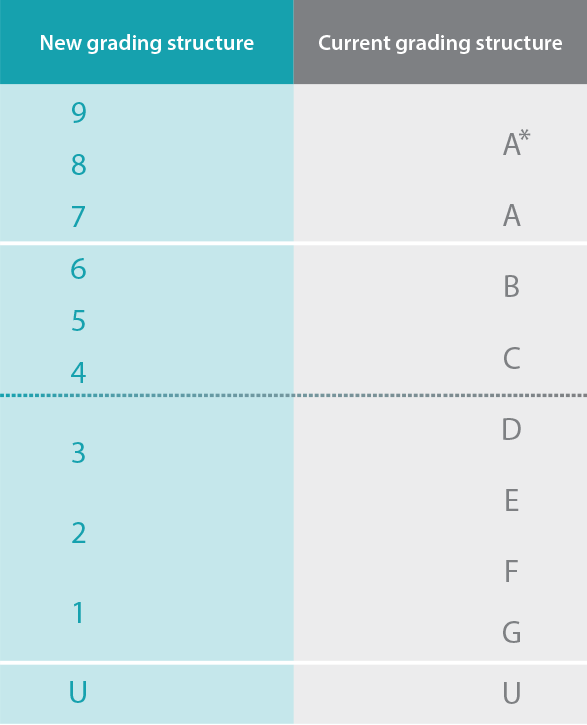
GCSEs in England have been reformed to keep pace with universities’ and employers’ demands. The new grades have replaced letters with numbers with 9 being the highest grade.
They are based on new and more demanding subject content but are still suitable for the same wide range of abilities. The new grade scale makes it clear to everyone that students have studied the new GCSEs.
It also has more higher grades compared to the old A to G grades, to give sixth forms, colleges, universities and employers the opportunity to better distinguish between students of different abilities.
For a table on equivalence see here.
Teaching is a job like few others. It can be stressful, rewarding, challenging, and funny, often within the same hour.
Our founder Lucy Kellaway has documented her experience in training to become a teacher and we would recommend her book: Re-Educated.
We would also recommend reading some of the case studies of our participants.
Sign up to our newsletter
Get regular updates from Now Teach. Including our blog, events announcements and latest news.